Slab Leak Detection & Repair
Find the failing supply pipe in or under the concrete floor, then decide how to fix it.
Repiping replaces the supply lines throughout a house. It makes sense when pipes leak again and again, flow weakens across the house or the water runs rusty.
Ask for a pipe condition test before agreeing to a full replacement.
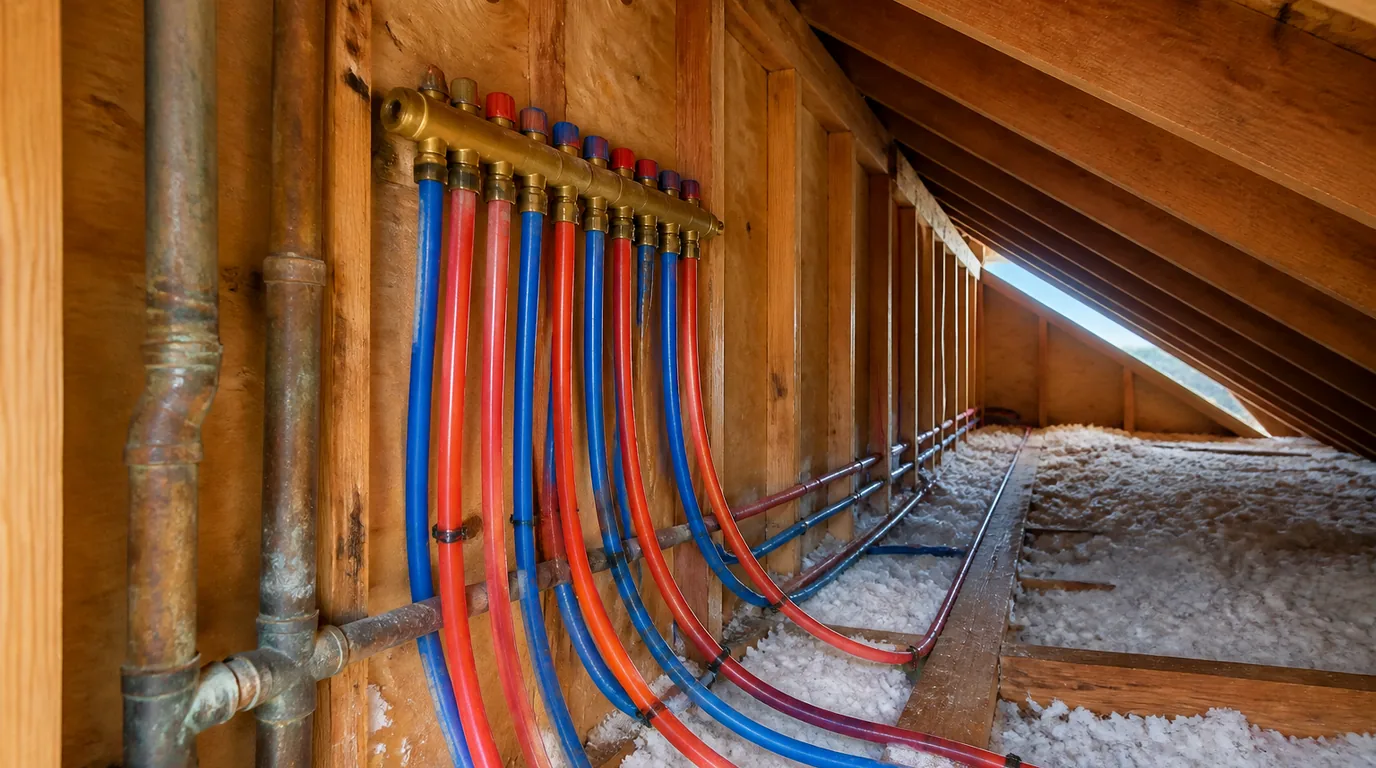
Repiping renews the supply lines to every fixture rather than a single failed stretch. The old pipe is left or removed, and new pipe runs through walls, attics or under the slab, depending on how the house was built.
It is different from a spot repair, which fixes one failure. Repiping is a bigger decision, so it should rest on evidence, such as a pattern of leaks or a failed pipe test, and not on a single event.
A house with repeated pinhole leaks in different places often has pipe that is wearing out from the inside. Rust-colored water, reduced flow at many fixtures and green staining on copper joints are other signs. Old galvanized steel can also clog from the inside as mineral scale narrows the bore.
Before agreeing, ask for the evidence: pressure readings, photographs of cut pipe or a camera look where access allows. Written findings make it easier to compare quotes.
Peoria and its neighbors include houses from several eras, from Old Town and the mid-century streets of Glendale and Youngtown to subdivisions that are only a few years old. A home's age is a good first guide to what is in the walls.
Water chemistry matters too. Ask your utility about the hardness and the treatment of your supply, because it influences how fast mineral scale builds in pipe and fixtures.
Repiping is quoted for the whole house. These factors move the figure the most.
Get at least two written quotes, and compare what each one includes rather than the bottom line alone.
Today's choices commonly include copper and PEX, a flexible plastic pipe. Copper is durable and familiar. PEX is quicker to install and can reduce the number of wall openings. Both have their fans, and the right one depends on the house, the water and your budget.
The Arizona Registrar of Contractors lists plumbing under classification R-37R for residential work. Ask the contractor for the license number and check it before you sign.
A repipe usually takes a few days for an average house, and water is off for part of that time. The crew opens small access points in walls and ceilings, runs the new lines and connects every fixture. Pressure testing comes before anything is closed up.
Drywall repair and paint often fall to another trade. Ask what the price covers, how the household will have water during the job and whether a permit is included.
PEX tubing is manufactured to ASTM F876 and copper tube to ASTM B88, and the plumbing code adopted locally lists which materials may be used. Ask which standard the quoted material meets. A repipe is a large contract, so confirm the license at roc.az.gov, the Arizona Registrar of Contractors site, before you sign anything.
Find the failing supply pipe in or under the concrete floor, then decide how to fix it.
Buried supply pipe trouble from meter to house, handled with a repair or a fresh run.
Track down hidden water loss using listening gear and thermal imaging, so only a small patch gets opened.
Repeated leaks, rust-colored water and weak pressure at many fixtures are the usual signs. A plumber can test the pipe and tell you whether a repair or a full replacement is the better path.
Most houses need a few days, depending on size and layout. Ask how many hours each day the water will be off.
It often does. Find out from the contractor who obtains the permit and when the inspector comes.
Yes, the line never closes. A repipe is planned work, but a pipe that is spraying or a ceiling that is dripping can be reported at any hour and handled first.
It depends on the home size, the number of fixtures, the pipe material and the access. Ask for a written quote that lists what is covered, including wall repairs.
The old pipe is removed or abandoned and new pipe is run to every fixture. The contractor should explain the material, the permit and the testing.
Sometimes. If the rest of the pipe is in good shape, a repair may hold. A camera or pressure test can help decide.
Call and describe the leaks or the water color. The person who answers will hand you to a contractor who can test the pipe first.
Service area centered on Peoria and nearby Maricopa County cities.